27 October 2026 · The Marble Network
How to Identify Genuine Italian Marble Before Buying
Italian marble refers to natural marble quarried in Italy. Different varieties have distinctive colours, veining patterns, and physical characteristics.
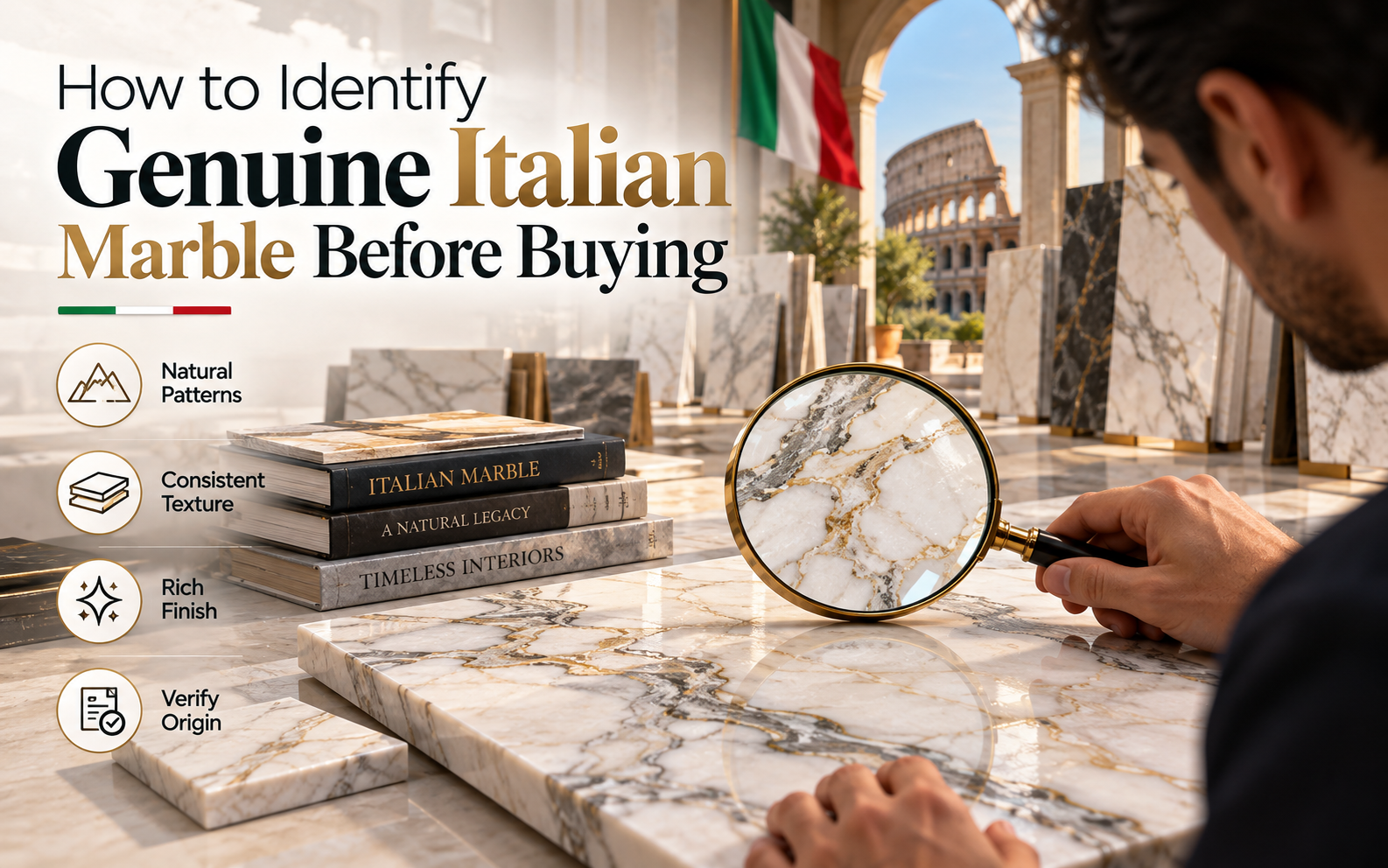
Italian marble is widely admired for its distinctive veining, elegant colours, and premium appearance. It is often used in luxury homes, hotels, villas, and commercial interiors to create sophisticated flooring, statement walls, and decorative surfaces. However, choosing genuine Italian marble requires more than judging a slab by its colour or shine. Similar-looking stones, alternative natural materials, and trade names can make it difficult for buyers to understand exactly what they are purchasing.
Before investing in marble, it is important to verify its origin, inspect the actual slabs, understand its natural characteristics, and review the supplier's documentation. This guide explains how to identify genuine Italian marble and avoid common buying mistakes.
Table of Contents
- What Is Italian Marble?
- Check the Origin and Product Documentation
- Examine the Colour and Natural Veining
- Inspect the Slab Quality and Surface
- Understand Marble Names and Varieties
- Questions to Ask Before Buying
- Common Mistakes to Avoid
- Frequently Asked Questions
- E-E-A-T: Expert Buying Guidance
1. What Is Italian Marble?
Italian marble refers to natural marble quarried in Italy. Different varieties have distinctive colours, veining patterns, and physical characteristics. Popular names include Carrara, Calacatta, and Statuario, each of which can vary depending on the specific stone and selected slab.
Italian marble is commonly chosen for living room flooring, luxury bathrooms, feature walls, staircases, and premium interior projects. Its appearance can range from subtle grey veining to dramatic patterns against a white background.
For homeowners planning Marble Design in India, understanding the difference between a marble's appearance and its verified origin is essential. A slab that looks Italian is not necessarily quarried in Italy. Similar patterns may occur in marble from other countries or in engineered materials.
2. Check the Origin and Product Documentation
The most reliable starting point is the supplier's documentation. Visual inspection can help assess a stone's characteristics, but it cannot independently prove where the marble was quarried.
Before purchasing, ask the seller for:
- Country-of-origin information: Request documentation that identifies the stone's origin.
- Supplier invoice: Ensure the invoice clearly describes the material being purchased.
- Product specifications: Confirm the variety, dimensions, thickness, and finish.
- Import or traceability documents: Ask for relevant supporting records where available.
- Written product description: Make sure the description matches the material quoted and delivered.
Buyers searching for Italian Marble in India should verify whether the seller is offering Italian-quarried marble or simply using a trade name associated with a particular appearance. If the seller cannot explain the product's origin or provide reasonable supporting information, consider comparing other suppliers.
3. Examine the Colour and Natural Veining
Natural marble forms through geological processes, so its patterns are rarely perfectly uniform. Differences in colour, veining, mineral deposits, and texture are normal characteristics of natural stone.
When examining a slab, look for:
Natural pattern variation: Genuine natural marble typically displays variations in its veins and background. However, these differences alone do not establish Italian origin.
Vein continuity: If multiple slabs will be installed together, check how the patterns relate to one another. This is particularly important for bookmatched walls and large flooring areas.
Background colour: Compare the slab under natural daylight and indoor lighting. White marble may have cool, warm, or grey undertones that affect the finished interior.
Surface characteristics: Look for natural fissures, filled areas, repairs, and visible defects. Ask the supplier to explain any features that could affect the appearance or performance of the stone.
Remember that photographs and small samples may not accurately represent a full slab. Buyers considering White Marble in India should inspect the actual material wherever possible before approving the final selection.
4. Inspect the Slab Quality and Surface
Even when the origin is verified, the condition of the individual slab matters. Genuine marble can still have defects, repairs, or characteristics that make it unsuitable for a particular application.
Check the following points before placing an order:
- Cracks and fissures: Ask an experienced stone professional to assess whether visible lines are natural features or structural concerns.
- Repairs and resin filling: Request disclosure of significant repairs or treatments that may affect the material's appearance or suitability.
- Thickness and dimensions: Confirm that the slabs match the agreed specifications.
- Finish consistency: Examine the surface for uneven polishing, scratches, or unwanted variations.
- Quantity and wastage: Check that the order includes sufficient material for cutting, matching patterns, and installation.
Do not rely only on the shine of a polished slab. Polishing can improve the appearance of many types of stone, so gloss is not proof of authenticity or superior quality.
5. Understand Marble Names and Varieties
Marble names can describe a recognised variety, a commercial category, or a trade name. Therefore, buyers should establish exactly what the supplier means by a product label.
For example, Statuario Marble in India is often associated with a white background and prominent grey veining. However, similar visual characteristics can appear in other stones, and the name alone does not confirm the quarry of origin.
Likewise, a product marketed as Michael Angelo Marble in India should be checked against its precise variety, source, and available documentation. Do not assume that a name or spelling variation automatically proves Italian origin.
If you are comparing suppliers in Kishangarh Marble in India, focus on transparent product descriptions, slab inspection, origin documentation, and clear invoices. Kishangarh is a major marble trading and processing centre, but the location where a product is sold does not establish where it was quarried.
When evaluating Quality Marble in India, consider traceability, slab condition, suitability for the intended use, and the supplier's willingness to answer questions clearly.
6. Questions to Ask Before Buying
Before finalising your purchase, ask the supplier these important questions:
- What is the exact marble variety and country of origin?
- Can you provide supporting origin or import documentation?
- Are the available slabs from the same batch or selection?
- Have the slabs undergone resin filling, repairs, or other treatments?
- What are the recommended installation, sealing, and maintenance practices?
- What happens if the delivered material differs from the approved selection?
Request a written quotation that specifies the material, thickness, finish, quantity, delivery conditions, and any additional charges. For expensive projects, consider having a qualified stone professional inspect the material before approval.
7. Common Mistakes to Avoid
One common mistake is choosing marble based entirely on online photographs. Lighting, editing, and differences between individual slabs can make the delivered material look different.
Another mistake is assuming that a high price guarantees authenticity. Price may reflect availability, grade, processing, or supplier margins, but it is not independent proof of origin.
Buyers should also avoid skipping the final slab inspection, overlooking installation costs, or choosing a finish without considering the room's requirements. A well-documented purchase and a clear agreement with the supplier can reduce misunderstandings.
8. Frequently Asked Questions
1. How can I confirm that Italian marble is genuine?
Ask for credible origin documentation, a detailed invoice, and precise product specifications. A visual inspection alone cannot reliably establish the marble's country of origin.
2. Can genuine Italian marble have natural veins and imperfections?
Yes. Natural marble can contain variations in veining, colour, mineral deposits, and fissures. A qualified professional can help distinguish acceptable natural features from defects that may affect performance.
3. Is Italian marble always white?
No. Italian marble is available in different colours and patterns, including white, grey, beige, and other shades, depending on the variety.
4. Does polished marble prove that it is genuine Italian marble?
No. Many natural stones can be polished to achieve a glossy finish. Surface shine does not establish the stone's origin or authenticity.
5. What should I check before making the final payment?
Verify the product description, origin information, dimensions, finish, slab condition, quantity, and written terms. Inspect the selected material and confirm delivery and installation responsibilities.
9. E-E-A-T: Expert Buying Guidance
A trustworthy marble-buying process combines product knowledge, careful inspection, transparent documentation, and professional advice. Because natural stone varies between slabs, no single visual characteristic can conclusively establish its origin.
For an informed purchase, request supporting records, compare actual slabs, obtain a detailed written quotation, and consult a qualified stone supplier or fabricator when necessary. Clear documentation and realistic information about maintenance help buyers make decisions based on evidence rather than marketing claims.
Conclusion
Identifying genuine Italian marble before buying requires more than recognising a familiar colour or vein pattern. Buyers should verify the stone's origin, review supporting documentation, inspect the actual slabs, and confirm that the material matches the agreed specifications.
By asking the right questions and working with transparent suppliers, homeowners can reduce the risk of purchasing misrepresented material and select marble that suits their design, budget, and long-term requirements.
Sourcing something like this?
Tell us the project and we will shortlist against spec, application and budget — not the catalogue.